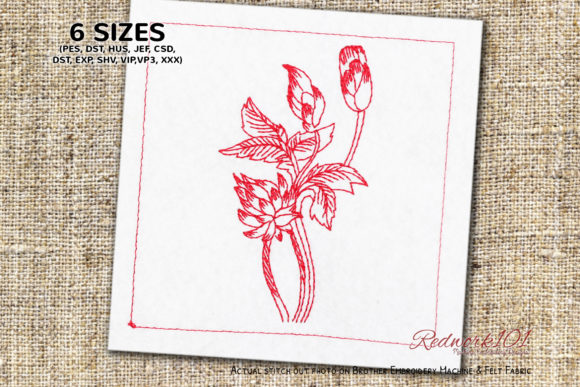
Lotus Flower: A Refined Redwork Embroidery Design Worth Your Thread
First Impressions: Graceful, Grounded, and Quietly Confident
When I opened the Lotus Flower embroidery file, what struck me wasn’t flash—it was presence. This is a single-flower design that breathes. The redwork style gives it an heirloom warmth, with clean line work and intentional negative space. It doesn’t shout; it invites closer looking. The petals unfurl with subtle asymmetry—just enough to feel hand-drawn, not algorithmically perfect—and the center detail suggests quiet complexity without overloading the eye. As a designer who’s stitched hundreds of floral motifs for client projects, I immediately saw its versatility: it belongs on a linen tea towel as much as it does on a baby onesie or a minimalist tote bag.
Real-World Test: Stitching It onto a Linen-Cotton Tote Bag
Last week, I prepped a custom order—a set of three embroidered canvas-and-linen blend tote bags for a local herbal apothecary. Their branding leans earthy, botanical, and unhurried. I chose Lotus Flower for the front panel, centered just below the strap seam. Using medium-weight cutaway stabilizer and 40-weight rayon thread in deep burgundy, I ran a test stitch on scrap fabric first—always non-negotiable. The design held beautifully: no puckering, no skipped stitches, and the redwork lines stayed crisp even at 8.5" wide. Customers later told me the stitching looked “intentional, not mass-produced”—a direct result of the design’s balanced proportions and restrained detail level. That’s the quiet power of Lotus Flower: it elevates the handmade product without competing with the fabric’s texture.
Where It Shines (and Where to Pause)
Lotus Flower performs exceptionally well across several high-demand use cases:
- Custom apparel: Works cleanly on sweatshirt cuffs, t-shirt hems, and cap fronts—especially when scaled to 3–5". Its open structure avoids dense fill-stitch fatigue on knit fabrics.
- Baby embroidery: Gentle curves and no tiny interior elements make it ideal for onesies and burp cloths. No risk of stiff, scratchy satin-stitch clusters near delicate skin.
- Embroidered patch: Clean outer edges and minimal underlay mean it cuts and finishes smoothly for iron-on or sew-on patches.
- Holiday and wedding gifts: Paired with ivory thread on oatmeal linen, it reads as serene and ceremonial—not trendy, but timeless.
- Etsy seller & small shop product: Photographs well in natural light, scales elegantly in printable mockups, and supports cohesive branding across kitchen towels, pillow covers, and aprons.
That said—here’s where attention matters:
- Small hoop sizes: If your machine’s smallest hoop is under 4", you’ll likely need to resize. Don’t force it—the outer petal tips and center lines lose clarity below ~2.75".
- Textured or stretchy fabric: On slubbed linen or lightweight jersey, use tear-away + topping. The running-stitch-based redwork relies on surface stability.
- Dark fabric: Redwork shines on light-to-mid tones. On charcoal or navy, test contrast with matte black or charcoal-gray thread—not just red. The design’s elegance depends on legibility, not color alone.
- Curved surfaces (like caps): The shape adapts well, but avoid placing it too close to the bill seam—petal flow can distort on tight curves.
Design Integrity Meets Commercial Practicality
What makes Lotus Flower more than just another floral motif? It carries weight without heaviness. Unlike many digital embroidery files that pile on fill stitches to “look expensive,” this one trusts line, rhythm, and pause. That translates directly to customer trust: when buyers see consistent stitch density and thoughtful spacing on your finished product, they read professionalism—not hobbyism. For Etsy sellers listing handmade goods, that difference affects perceived value, repeat orders, and word-of-mouth referrals.
I’ve used it in boutique branding kits—paired with simple serif typography on packaging—and watched how it softens hard edges without fading into background noise. It also holds up in black-and-white mockups, which matters if you’re building a cohesive digital portfolio or offering monochrome embroidery options.
Practical Designer Notes Before You Stitch
Before adding Lotus Flower to your next project—or listing it as part of a commercial embroidery collection—take these five minutes:
- Test on scrap fabric that matches your final substrate, with the same stabilizer and thread.
- Check thread color contrast against both light and dark backgrounds—you’ll likely want two thread palettes ready.
- Review stitch density visually in your embroidery software. Look for tight corners or overlapping runs—this design avoids them, but always verify.
- Confirm hoop size compatibility. While the Box Stitch shown is optional (and best omitted for lightweight items), ensure the main motif fits comfortably within your standard hoops.
- Inspect small details at 200% zoom: petal tips, stem taper, and center definition should remain distinct—not fused or pixelated.
And one non-negotiable: confirm licensing terms before selling finished items or bundling Lotus Flower into digital design assets. As a craft business owner, protecting your reputation means respecting the creator’s rights—and ensuring your customers receive exactly what they expect from a premium machine embroidery design.
Final Thought: Not Just a Flower—A Design Decision
You don’t choose Lotus Flower because it’s floral. You choose it because it aligns with intention: slow making, thoughtful gifting, quiet confidence in craft. Whether you’re embroidering a nursery wall hanging, updating your small shop’s holiday collection, or designing a signature embroidered patch for your apparel line—it supports your voice instead of overriding it. In a market crowded with busy, over-digitized florals, Lotus Flower is the pause that feels like purpose. And in embroidery, as in life, the most memorable marks are often the ones that leave room to breathe.