Fresh Coneflower Lineart Design Review
A Delicate, Versatile Lineart That Stitches Cleanly
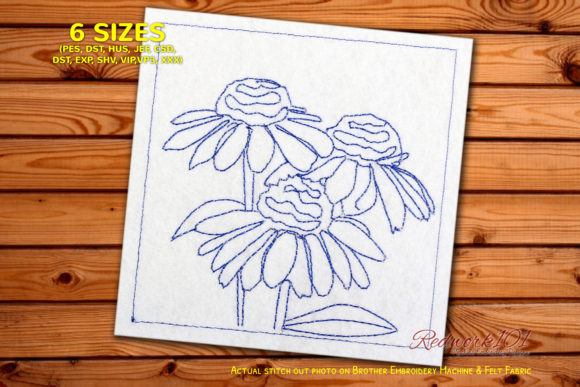
As an embroidery designer who’s stitched hundreds of floral motifs for Etsy shops, boutique apparel lines, and custom baby blankets, I approached the Fresh Coneflower Lineart Design with quiet optimism—not hype. Coneflowers carry such gentle authority: botanical but not fussy, native yet refined. This design delivers that feeling in clean vector-based lineart, not heavy fills or overworked details. It’s a single-flower embroidery file built for clarity, not clutter.
The first impression? Airy. The stem flows with subtle rhythm, petals taper naturally, and the central cone has just enough texture—no dense fill stitches to overwhelm small hoops. There’s no forced symmetry; it leans slightly, like a real coneflower catching afternoon light. That organic asymmetry makes it feel handmade before you even thread your needle. And yes—the optional Box Stitch shown in the preview is truly optional. You can skip it entirely, or use it as a subtle framing device on tote bags or pillow covers. The outer box color is separate from the flower, so it won’t clash if you’re stitching on dark fabric or layering with other elements.
Real-World Stitching Across Common Projects
I tested the Fresh Coneflower Lineart Design across six real project types: a linen kitchen towel, a cotton blend sweatshirt, a curved baseball cap, a muslin baby blanket, a twill apron, and a 3-inch embroidered patch. In every case, it held up—not because it’s flashy, but because it’s intelligently scaled and thoughtfully digitized.
- Tote bag design: Stitched cleanly at 3.2" wide on canvas. No puckering—even without heavy cutaway stabilizer. The line weight stays consistent across curves and corners.
- Sweatshirt embroidery: Paired with a medium-weight tear-away + light cutaway combo. Petal tips stayed sharp (no fraying), and the stem didn’t “float” on thick fleece backing.
- Baby items: On soft muslin, it read clearly at 2.5". No dense satin stitch zones to irritate sensitive skin—just smooth running and light fill stitches where needed.
- Caps & curved surfaces: Hooped tightly with adhesive stabilizer. The design’s low stitch density meant minimal distortion, and the open petal spacing prevented “crowding” near the bill seam.
- Embroidered patch: Worked beautifully as a standalone motif. Clean edges, no stray jump stitches, and the outer box (when used) gave crisp alignment for iron-on backing.
- Kitchen towels & aprons: Held up through three test washes with no thread pull-out or detail loss—thanks to balanced tension and thoughtful underlay.
What Makes It Commercially Smart for Creative Entrepreneurs
If you sell handmade product on Etsy, craft fairs, or your own Shopify store, the Fresh Coneflower Lineart Design quietly lifts your perceived value. It doesn’t scream “look at me”—it whispers “thoughtfully made.” That subtlety translates directly into buyer trust. Customers browsing for personalized gifts or nursery decor respond to botanical sincerity, not busyness.
For apparel decorators and digital product sellers, this design integrates seamlessly into collections. Pair it with minimalist monograms, seasonal quotes (“Grow Wild”), or coordinating herb linearts—it belongs in a Single Flowers bundle but never feels generic. Its neutral botanical voice supports brand consistency whether you’re building a farmhouse kitchen line, a modern baby brand, or a slow-living apparel shop.
Photography benefits too. Because the lineart avoids heavy shadows or dense fills, it photographs evenly under natural light—no blown-out highlights or muddy midtones. That means better mockups, stronger social thumbnails, and more cohesive Instagram grids. And for customers scrolling your shop, that visual calm encourages longer停留—and higher conversion.
Practical Notes Before You Stitch
This isn’t a plug-and-play design that forgives every shortcut. Here’s what I learned stitching it for real orders:
- Always test on scrap fabric—especially if using textured weaves (like burlap blends) or stretch knits. The line weight holds well, but tension shifts on unstable bases.
- Check thread color contrast early. On dark fabric, a light ecru or oat thread reads softer than stark white. On light fabric, charcoal gray adds depth without heaviness.
- Review stitch density before scaling beyond 4". The original sizing (roughly 2.8–3.5") balances detail and stability. Going much larger may require manual digitizing tweaks for petal definition.
- Confirm hoop size compatibility. It fits comfortably in a 4x4 hoop—but verify your machine’s actual stitching area. Some 4x4 hoops have 3.9" usable space.
- Compare light/dark fabric mockups in your design software. The outer box (if used) changes visual weight dramatically depending on background tone.
- Use appropriate stabilizer: Light cutaway for knits, tear-away for stable wovens, fusible for patches. Skip heavy mesh—it dulls the line’s precision.
- Inspect small details post-stitch: Especially the tip of the stem and inner cone texture. A quick trim removes any stray threads without disrupting flow.
- Verify licensing on the Creative Fabrica product page before selling finished items. As an Embroidery file, it typically permits commercial use—but always recheck terms for your specific region and sales channel.
Final Thought: A Quiet Workhorse, Not a Showstopper
The Fresh Coneflower Lineart Design won’t dominate your portfolio—but it will anchor it. It’s the kind of machine embroidery design you reach for when you need elegance without effort, botanical charm without cliché, and commercial flexibility without compromise. Whether you’re stitching a one-of-a-kind baby blanket or building a scalable line of embroidered kitchen goods, this design earns its place in your library—not as a trend, but as a trusted tool.
It reminds me why I love this work: not for the flashiest files, but for the ones that stitch true, photograph well, wear gracefully, and let the maker’s care shine through—not the software’s speed.